
TSTS Meaning in Text: What Does It Really Mean?
TSTS Meaning in Text is trending online because more people are seeing “TSTS” in messages, captions, and social media posts—but many aren’t sure what it means. If you’ve wondered about it, you’re not alone. In simple terms, TSTS Meaning in Text refers to a slang expression that represents mild disapproval, annoyance, or playful scolding. It’s like typing out the “tsk tsk” sound to show someone that what they did wasn’t quite right.
⚡ Quick Answer: TSTS Meaning in Text
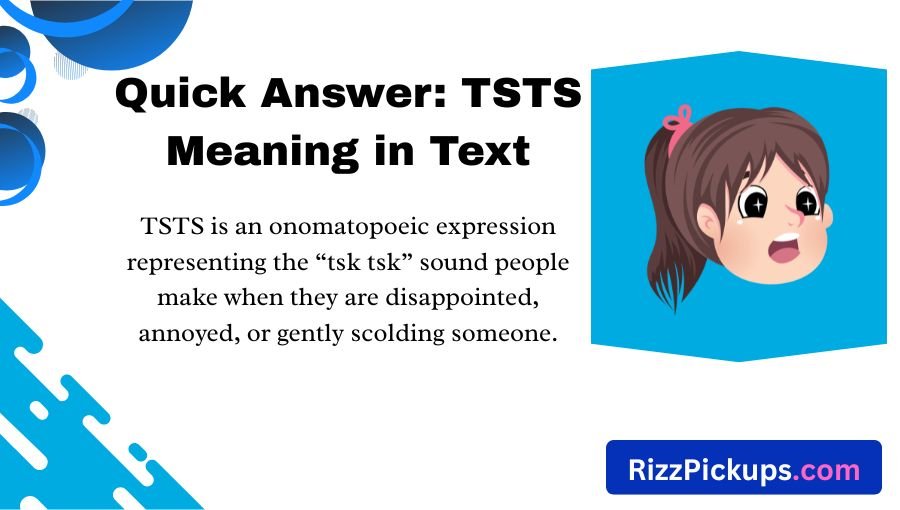
TSTS is an onomatopoeic expression representing the “tsk tsk” sound people make when they are disappointed, annoyed, or gently scolding someone. In texts, it conveys disapproval without sounding harsh.
📚 Core Content Sections
TSTS Meaning in Texting and Messaging
In everyday texting, TSTS is similar to saying “tsk tsk” in real life. It indicates mild frustration, disapproval, or a playful scolding. For example:
- Friend: “I forgot your birthday 😬”
- You: “TSTS… that’s not nice!”
It’s informal and usually friendly, making it perfect for casual messaging.
Also Read This: IKTR Meaning in Text
TSTS Meaning in Love and Relationships
In romantic contexts, TSTS can be playful or teasing. Partners might use it to lightly chide each other without starting a serious argument. For example:
- Partner: “I ate the last cookie 🙈”
- You: “TSTS… you know I was saving that!”
Here, it expresses gentle reproach mixed with affection.
TSTS in Slang and Casual Language
As slang, TSTS conveys a quick reaction to minor mistakes or unexpected behavior. It’s often used among friends or peers to show that something is not quite right—but in a non-serious way.
- Example: “TSTS, late again? You really need an alarm clock 😏”
The tone is casual, playful, or sarcastic depending on the situation.
TSTS on Social Media Platforms
On platforms like TikTok, Instagram, and Snapchat, TSTS appears in captions, comments, and short video reactions. Users often combine it with emojis like 🙄, 😬, or 😏 to emphasize the mood.
- Example Caption: “When your friend cancels plans last minute… TSTS 🙄”
This shows disapproval or mild annoyance while keeping the post light-hearted and relatable.
Spiritual or Symbolic Meaning
While TSTS doesn’t have a widely recognized spiritual meaning, some interpret it as a symbol of gentle correction or moral reminder. In this sense, it can subtly convey that something needs attention without being harsh.
Numerology or Cultural Meaning
TSTS does not have an official numerological or cultural meaning. However, in online culture, it reflects common communication trends where sound-based expressions are typed out to represent feelings and reactions quickly.
🧠 Examples & Usage
Here are some real-life examples of TSTS in context:
| Scenario | Text Example | Meaning |
|---|---|---|
| Friend forgets an event | “TSTS… you really need to pay attention 😏” | Mild disapproval |
| Romantic teasing | “TSTS… stealing my fries again?” | Playful chiding |
| Social media comment | “TSTS, another Monday already 😬” | Mild frustration or annoyance |
| Casual conversation | “TSTS… you never learn, do you?” | Slight sarcasm |
Notice how context changes the tone: in romance it’s playful, in friendship it’s teasing, and on social media it’s often relatable humor.
❓ Common Questions (FAQ)
What does TSTS really mean?
It represents a “tsk tsk” sound, showing mild disapproval, annoyance, or gentle scolding.
Is TSTS positive or negative?
It is generally neutral. It can be playful, teasing, or slightly critical depending on context.
Is TSTS romantic?
It can be, when used lightly between partners to tease or playfully scold.
How should someone reply to TSTS?
You can respond with a laugh, explanation, or another playful text. Example: “Oops 😬 my bad!”
🏁 Conclusion
In simple terms, TSTS is an informal way to express mild disapproval, annoyance, or playful scolding in texts and online conversations. Whether you’re chatting with friends, teasing a partner, or posting on social media, you now know how to use it correctly. Next time you see TSTS, you’ll understand exactly what it means—and maybe even use it yourself!