
What Does STI Mean? (Full 2026 Guide to Meaning, Usage & Examples)
The term STI (Sexually Transmitted Infection) is becoming increasingly searched online in 2026 as more people look for clear, simple explanations of health-related terms they see in conversations, social media, and medical advice. Many users encounter the abbreviation STI and immediately search for “What does STI mean?” because they are unsure of its context or seriousness.
In simple terms, STI means Sexually Transmitted Infection, which refers to infections that are spread from one person to another through sexual contact. It is a medical term used by doctors, health educators, and health organizations worldwide.
⚡ Quick Answer: What Does STI Mean?
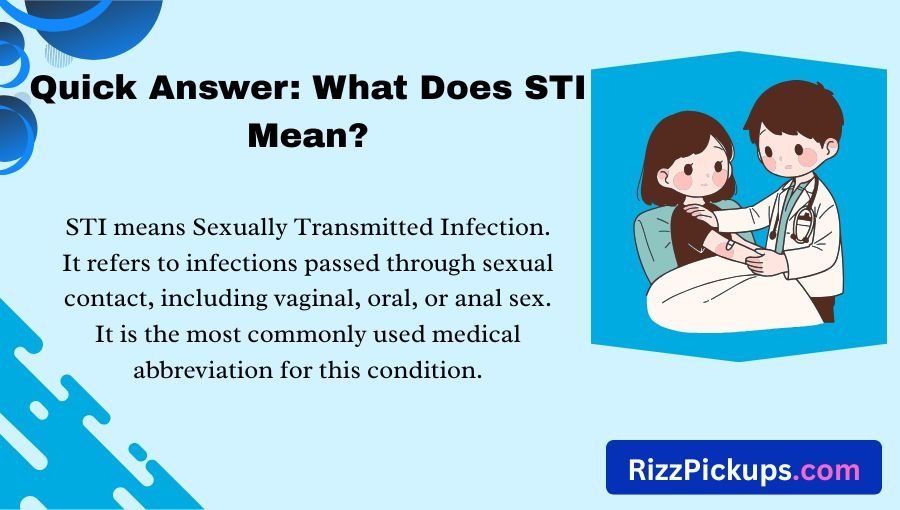
STI means Sexually Transmitted Infection.
It refers to infections passed through sexual contact, including vaginal, oral, or anal sex. It is the most commonly used medical abbreviation for this condition.
📚 What Does STI Mean in Different Contexts?
🧬 STI Meaning in Health & Medicine
In medical language, STI (Sexually Transmitted Infection) refers to infections caused by bacteria, viruses, or parasites transmitted through sexual activity.
Common STIs include:
- Chlamydia
- Gonorrhea
- Syphilis
- HIV
Important facts:
- Some STIs have no symptoms
- Testing is the only way to confirm many infections
- Early treatment can prevent complications
Also Read This: TMU Meaning in Text
💬 STI in Texting and Messaging
In texting, STI is usually used in a serious or informational way, not as slang.
Examples:
- “Did you book your STI test?”
- “STI results came back negative.”
👉 It is mostly used when discussing health, not casual chat.
❤️ STI in Love and Relationships
In relationships, STI often comes up in health and trust conversations.
Typical usage:
- Before becoming physically intimate
- When discussing sexual health history
- When building trust between partners
Example:
- “We should both talk about STI testing before we take things further.”
👉 Here, STI represents responsibility, safety, and honesty.
📱 STI on Social Media (TikTok, Instagram, Snapchat)
On social media, STI is commonly seen in:
- Health awareness posts
- Educational videos
- Relationship advice content
Examples:
- “Get regular STI tests 💙 stay safe”
- “STI awareness saves lives”
👉 It is mainly used for education and awareness, not slang trends.
🧠 STI in Slang and Casual Language
Unlike many abbreviations, STI is not widely used as slang.
Even in casual speech, it keeps its medical meaning:
- “I need to get an STI check-up.”
👉 It remains a formal or health-related term in most cases.
🌍 Spiritual or Symbolic Meaning
STI does not have a recognized spiritual or symbolic meaning.
If used metaphorically, it depends entirely on personal interpretation rather than cultural tradition.
🔢 Numerology or Cultural Meaning
There is no numerology or cultural symbolism associated with STI.
Its meaning is strictly medical and informational.
🧠 Examples & Usage in Real Life
| Context | Example |
|---|---|
| Medical | “The clinic offers free STI testing.” |
| Relationship | “We should discuss STI screening.” |
| Awareness | “STI prevention starts with education.” |
| Personal health | “My STI results were clear.” |
🔁 How Context Changes Meaning
- Clinics → medical diagnosis
- Relationships → trust & safety
- Social media → awareness
- Messaging → health discussion
❓ Common Questions (FAQ)
What does STI really mean?
STI means Sexually Transmitted Infection, a medical term for infections spread through sexual contact.
Is STI positive or negative?
STI is neutral as a term, but it refers to a health condition that may require treatment.
Is STI romantic?
No, STI is not romantic. It is strictly related to sexual health and medical safety.
How should someone reply to STI?
It depends on context:
- Health discussion: “Thanks for sharing—getting tested is important.”
- Relationship talk: “We should both get checked.”
- Awareness: “Yes, prevention and education matter.”
🏁 Conclusion
To summarize, STI means Sexually Transmitted Infection, a medical term used to describe infections spread through sexual contact. It is commonly seen in healthcare, relationships, and awareness campaigns, and understanding it helps people stay informed and make safer health decisions.
Now you clearly understand what STI means and how it is used in different contexts.